
How to drain you expansion tank
I would like to start out by saying you should not have to drain your expansion tank if properly installed. For proper installation see the link. The easy way to tell if the tank needs to be drained is to watch the pressure when the boiler is running. The pressure should not change much from a cool start to a hot shut down. The pressure should not change more than 5 psi. When draining the tank, you must always completely drain the tank of water to get the proper air charge
How to drain the tank.
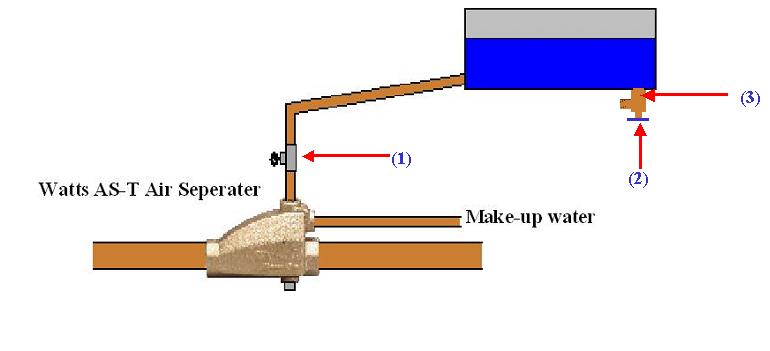
1. Turn the boiler off
2. Close the valve to isolate the tank from the system (1)
3. Connect a hose to the tank drainer (2) or drain valve if no tank drainer
4. Open valve
5. Drain until the water stops draining and open the vent on the side of the drain valve (3). If no vent loosen hose slightly to allow air to get into the tank. If that does not work drain with a bucket so air can get into the tank to break the vacuum.
6. When the tank is completely empty remove the hose. I like to do this before I close the tank valve to verify the tank is completely drained. Close the tank valve.
7. If you removed the plug replace the plug verifying it is tight so no air will leak out of the tank when the tank is pressurized.
8. Open the system isolation valve slowly to allow the tank to refill. You should hear the auto feeder if you have one start to feed. The water pressure should shut down somewhere around 12 psi for two story home or less. Never operate below 12 psi. Three stories or more you will need higher water pressure.