Residential Gas Piping Inrformation
Ask Your Boiler and System Questions or Leave Your Comments Here
Sizing Gas Piping Layout
You might wonder why it's important to understand how to size gas lines. Here are several reasons to know how to size a new gas line or to check whether the current gas line is correctly sized.
- When replacing the heating appliance
- Replacing a gas boiler and gas tank-type water heater with a combi boiler (heat and domestic Hot water)
- New construction with natural and LP gas
- When the existing system cannot maintain proper incoming gas pressure
- Converting oil to gas
- To assess if the current gas piping can adequately handle the addition of another gas appliance.
We will show you that sizing gas lines for the home is easy. We will provide the details, accompanied by charts and a few piping layouts. You will also be able to download a couple of worksheets. After completing them, you can check your work by clicking the links with answers.
There are three basic types of calculations for residential gas lines.
- Longest Length Calculation - This is what we will teach on this page.
- Branch Length Calculation - Another page link when ready
- Manifold Home Run System - Another Page link when ready
There are 34 basic types of pipes that can be used in most areas of the US. The last is becoming questionable in many areas
There are four types of pipes used for residential gas.
- Black Iron pipe- Most common
- Galvanized iron pipe - Not everywhere, check with your local code
- CSST - Corragated Stainles Steel Pipe close second most common
- Yellow PEX - Direct bury pipe for underground use only, requires special fittings
Let's start with a standard pipe calculation from the meter to the furthest point. We need to gather some information before starting. Once we have gathered all the information listed below, we must select the appropriate chart from the 32 available charts based on the fuel type, pressures, and piping material. We will only address the use of black pipe. All the charts are applied in the same way.
Sizing Iron Pipe Gas Lines
We must first do a fact-finding mission. We need to understand the layout, the existing appliance sizing, and what we will be adding. Let's list them.
- Total Load -Connected load by appliance and Btu/h
- Btu's or CFH chart-We will supply
- Drawing -Proposed piping layout
- Fuel Type -Natural or LP
- Heating Value -Get this from the fuel supplier
- Longest Pipe - Longest Pipe from meter to furthest appliance
- Pressure Drop -Your choice. We suggest 0.5" w.c. or 0.3" w.c.
Gathered Information
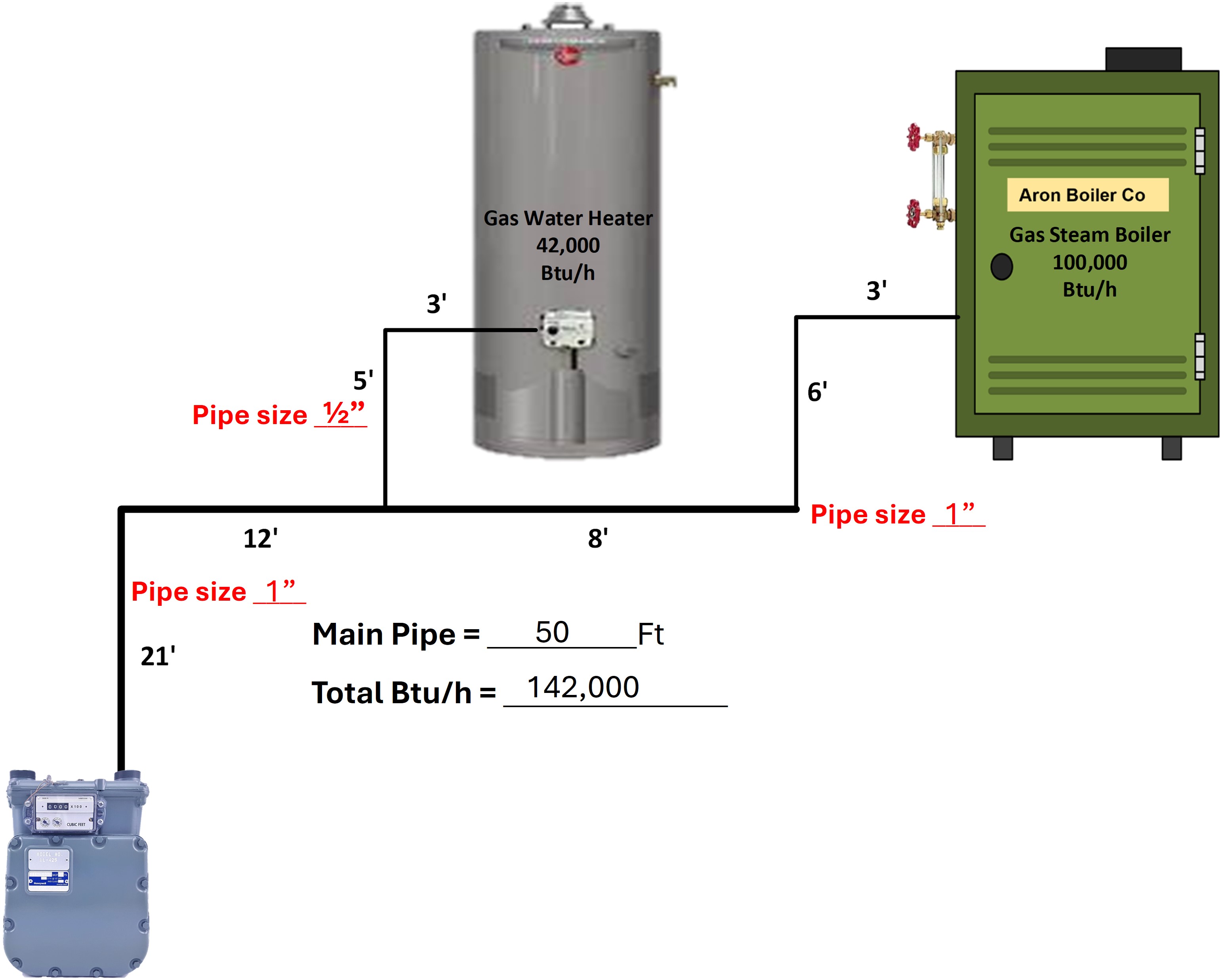
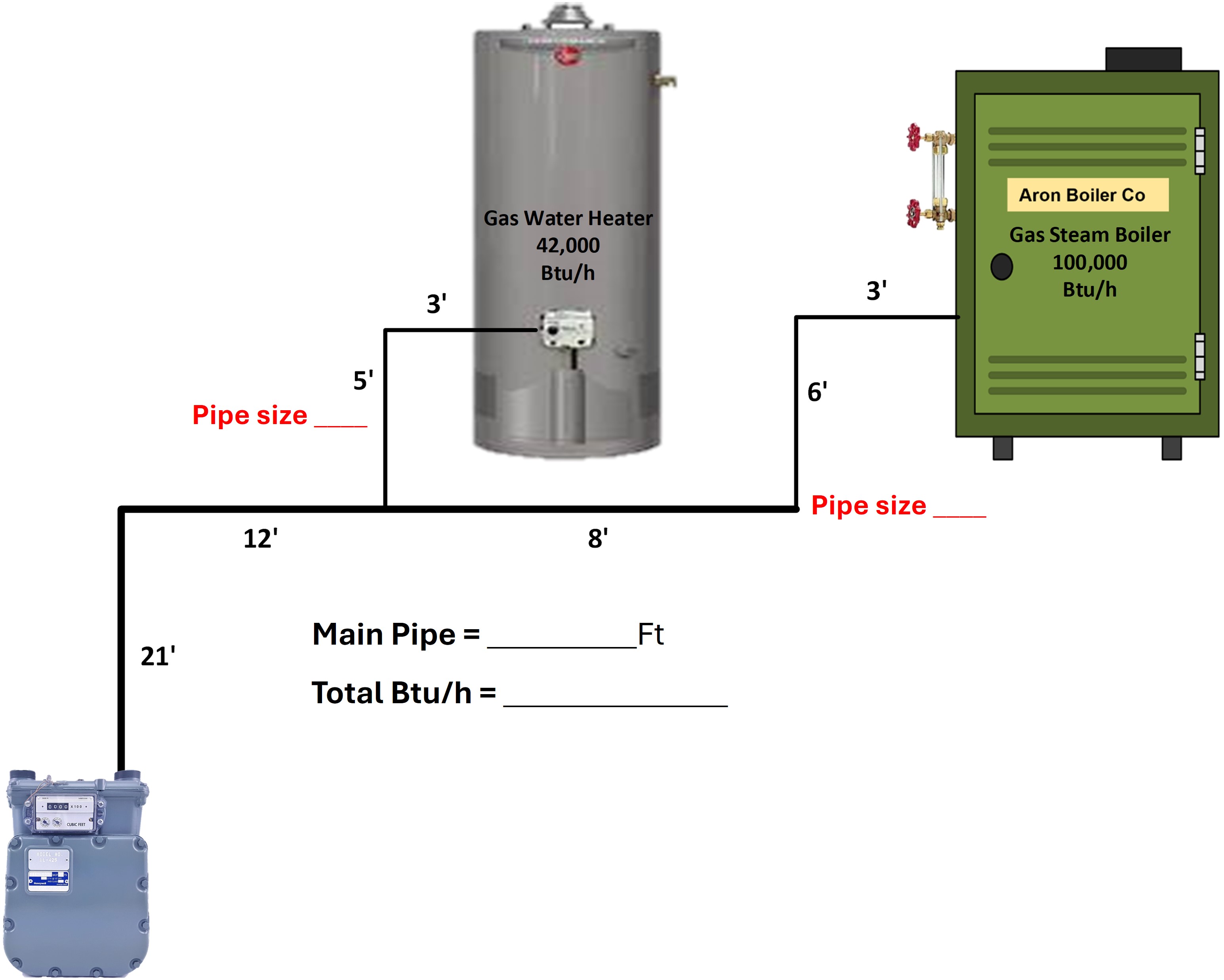
Here is the layout.
- Water Heater - 42,000
- Boiler - 100,000
- Total Load - (42,000 + 100,000) 142,000 Btu/h (below)
- Btu/h or Cubic CFH - Let's Btu/h
- Longest Pipe - 50 ft. (21'+ 12'+ 8'+ 6'+ 3')
- Pressure Drop - 0.5" w.c.
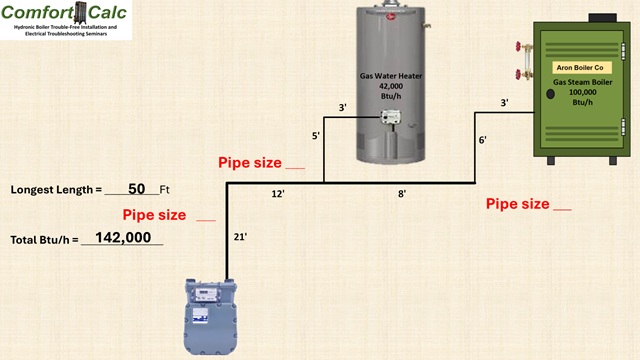
Let's fill in the blanks
Calculations for the longest-length method determine the longest pipe from the meter or pressure regulator to the furthest appliance. In the above example, the longest pipe is 50 ft. This means that for each application, you must always use the 50-foot line or column, highlighted below, depending on the chart layout. Here is the chart for Natural Gas. I have highlighted the 50-foot line. When calculating the longest pipe, if the pipe is 1 foot over the length in the chart, go to the next line. For instance, if the pipe is 41 ft to 50 ft, you use the 50 ft line. At 51 ft, go to the 60 ft line. If a chart you are using for natural gas is using Cubic feet, divide the Btus by 1000, and if it is LP, divide btu's by 2616
Natural Gas BTU/h Pressure Chart

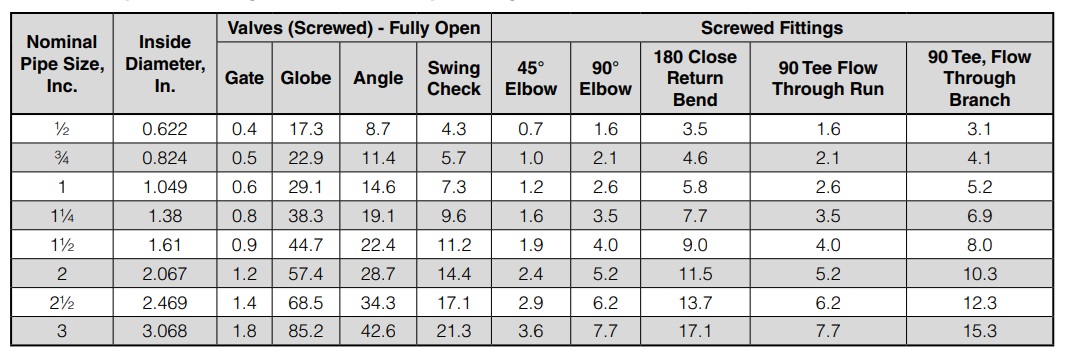
You may hear sometimes that you have to add equivalent feet of pipe for fittings. This is not true for residential gas systems with the longest loop. It's normal to use the 2 PSI or less chart and .5" water column pressure drop; you do not have to count for fittings. There is enough fudge in the charts to avoid using a fitting equivalent.
Using this chart with the Longest Length Method, we identify the appliance load and locate the load in the 50 ft row that meets or exceeds the appliance's required load. We begin by calculating the main pipe. Our load amounts to 150,000 BTUs. Starting at the 50-foot mark and moving right until we can supply at least 142,000 BTUs, we find that a 1" pipe is needed. The water heater has a 42,000 BTU input. We will begin from the left side and proceed rightward to determine the appropriate pipe size. The first column shows that a 1/2" pipe can deliver 46,000 BTUs, and since we only require 42,000, a 1/2" pipe is needed from the main to the water heater. Finally, for the boiler rated at 100,000 BTUs, using the same approach, we start at the 50-foot line and look for a load of 100,000 or more. The 3/4" pipe delivers only 98,000 BTUs, which is less than 100,000, so a 1" pipe must be used for the boiler..
Click here for the answer (Use your back button to return to this page)
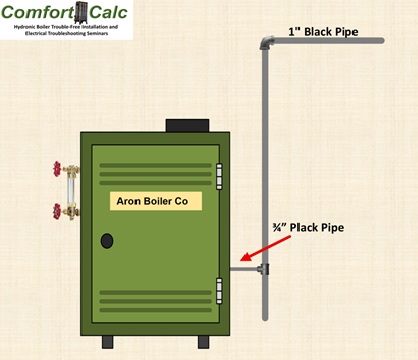
To avoid confusion, the gas valve will probably have a 3/4" taping, so we run the 1" all the way to the boiler and down along the boiler to a tee, and reduce to 3/4" to the gas valve. Remember the code requires a dirt trap from that tee, add a 4" nipple down and cap it.
 Disclaimer: The information found on this website is for informational purposes only. All preventive maintenance, service, and installations should be reviewed on a per-job basis. Only qualified, experienced personnel should perform work on your heating system. Comfort-Calc or its personnel accepts no responsibility for improper information, application, damage to property, or bodily injury from applied information found on this website.