
Adding a Boiler to an Existing Boiler
But you only want one to run at a time
I have been asked about adding a boiler to an existing boiler. The first question I usually get asked is, "can I pipe it like multiple boiler installation?" Yes, you could, but that calls for a lot of extra piping. If you utilize the existing piping and add the second boiler piped to a set of close spaced tees for hydraulic separation it would work fine. This is a situation where you are not staging the boiler to meet the heat loss of the building but instead one boiler is designed to run as a stand-alone boiler. You are choosing to run one boiler or the other. I have used this in situations where there was an old oil boiler, and the customer wants a new gas boiler. He also wants to keep the oil boiler as a back-up boiler or to use during price spikes.
I would not do this with a wood boiler as the second boiler should be electrically disconnected from each other. Therefore, boiler two does not take over when the wood fire goes out. The idea here is one or the other and we will wire it so it is not possible to run both boilers at the same time . The manual switch can only send voltage to one boiler at a time.
We are actually going to combine primary/secondary piping with standard cast iron manifold piping. This is very easy especially if the cast iron boiler has a boiler bypass installed already for boiler protection
If the existing boiler does not have a boiler bypass loop already installed, it must be installed and pipe the new gas boiler in per the following diagram utilizing closely spaced tees.
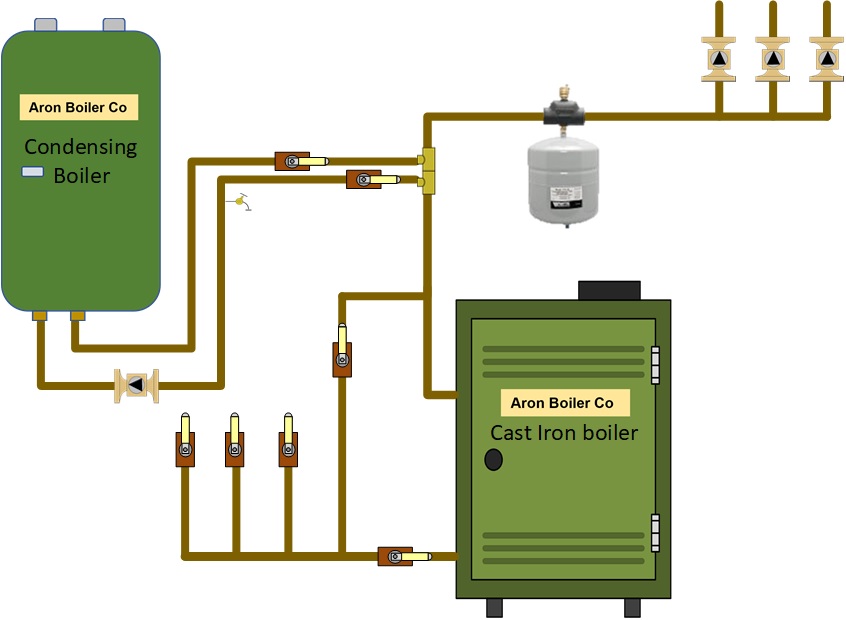
Many old systems will have the circulators mounted on the return side of the boiler. This would be a good time to have them moved. The circulators work best on the supply side of the boiler pumping away from the expansion tank. This is shown in the last drawing. The tee's the gas boiler (left boiler) is piped into the existing piping with need to be as close as possible.
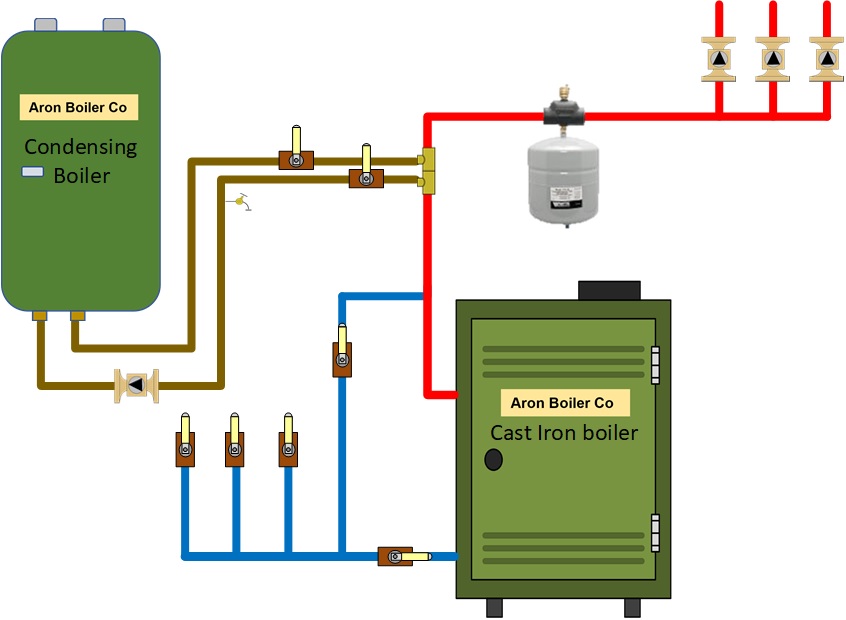
When operating the gas boiler valve off the oil boiler so the flow goes as shown below. This would also work with zone valves instead of zone pumps.
If you want the oil boiler to run, valve so the flow is as follows.
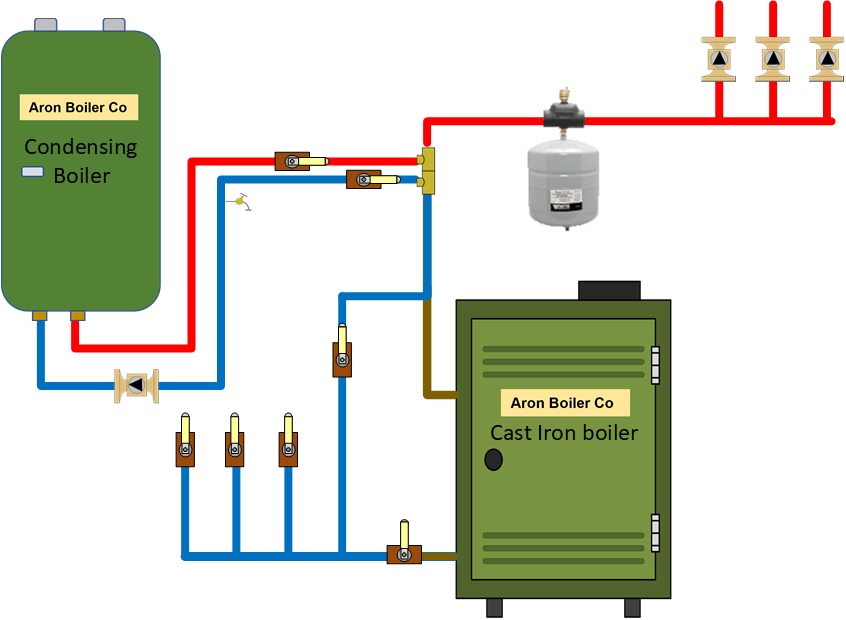
You will probably be cutting into the piping to add bypass pipe and valves so take the time and expense to move the circulators now so it looks like diagram above.
Disclaimer: The information found on this website is for informational purposes only. All preventive maintenance, service, installations should be reviewed on a per job situation. Any work performed on your heating system should be performed by qualified and experienced personnel only. Comfort-Calc or its personnel accepts no responsibility for improper information, application, damage to property or bodily injury from applied information found on this website as it should be reviewed by a professional.