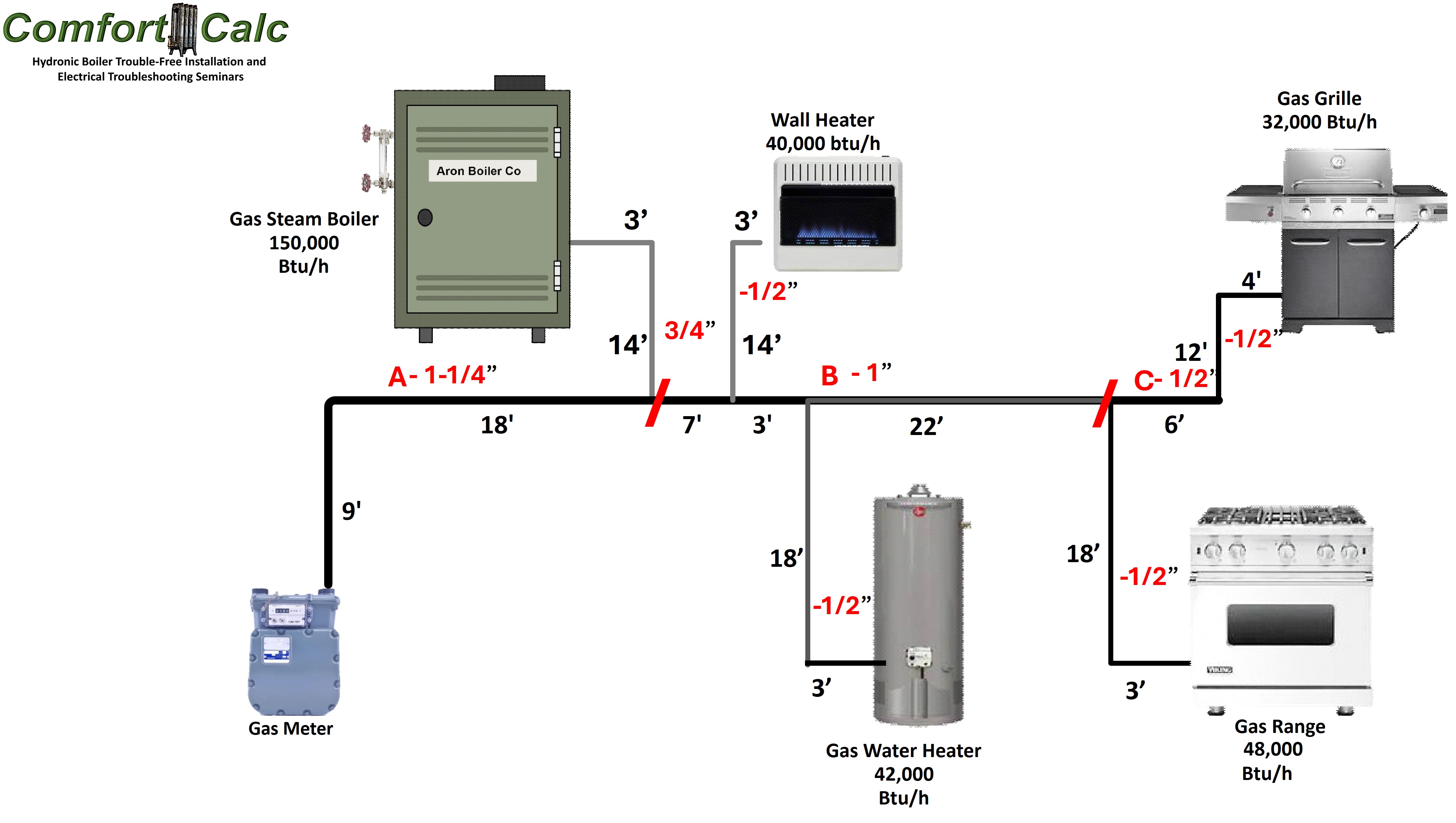
Sizing Gas Piping Layout
- When replacing the heating appliance
- Replacing a gas boiler and gas tank-type water heater with a combi boiler (heat and domestic Hot water)
- New construction with natural and LP gas
- When the existing system cannot maintain proper incoming gas pressure
- Converting oil to gas
- To determine if the current gas piping can adequately handle the addition of another gas appliance.
There are three basic types of calculations for residential gas lines.
- Longest Length Calculation - Longest-Length Calculation Link
- Branch Length Calculation -Read Below
- Manifold Home Run System - Mix of Iron Pipe and CSST Link
There are four types of pipes used for residential gas.
Sizing Residential Iron Pipe Gas Lines
We must first do a fact-finding mission. We need to understand the layout, the existing appliance sizing, and how many Btu/h we will be adding in Btus or CPH.
Here is a list of what is needed.
- Total Load -Connected load by appliance and Btu/h
- Btu's or CFH chart-We will supply this for this exercise. It is best to get a chart from the code books.
- Drawing -Proposed piping layout, make the measurement as accurate as possible
- Fuel Type -Choose Natural or LP gas
- Heating Value -Get this from the fuel supplier
- Longest Pipe - Dertemine the longest pipe from the meter to furthest appliance
- Pressure Drop -Your choice for natural gas, we suggest 0.5" w.c. or 0.3" w.c.
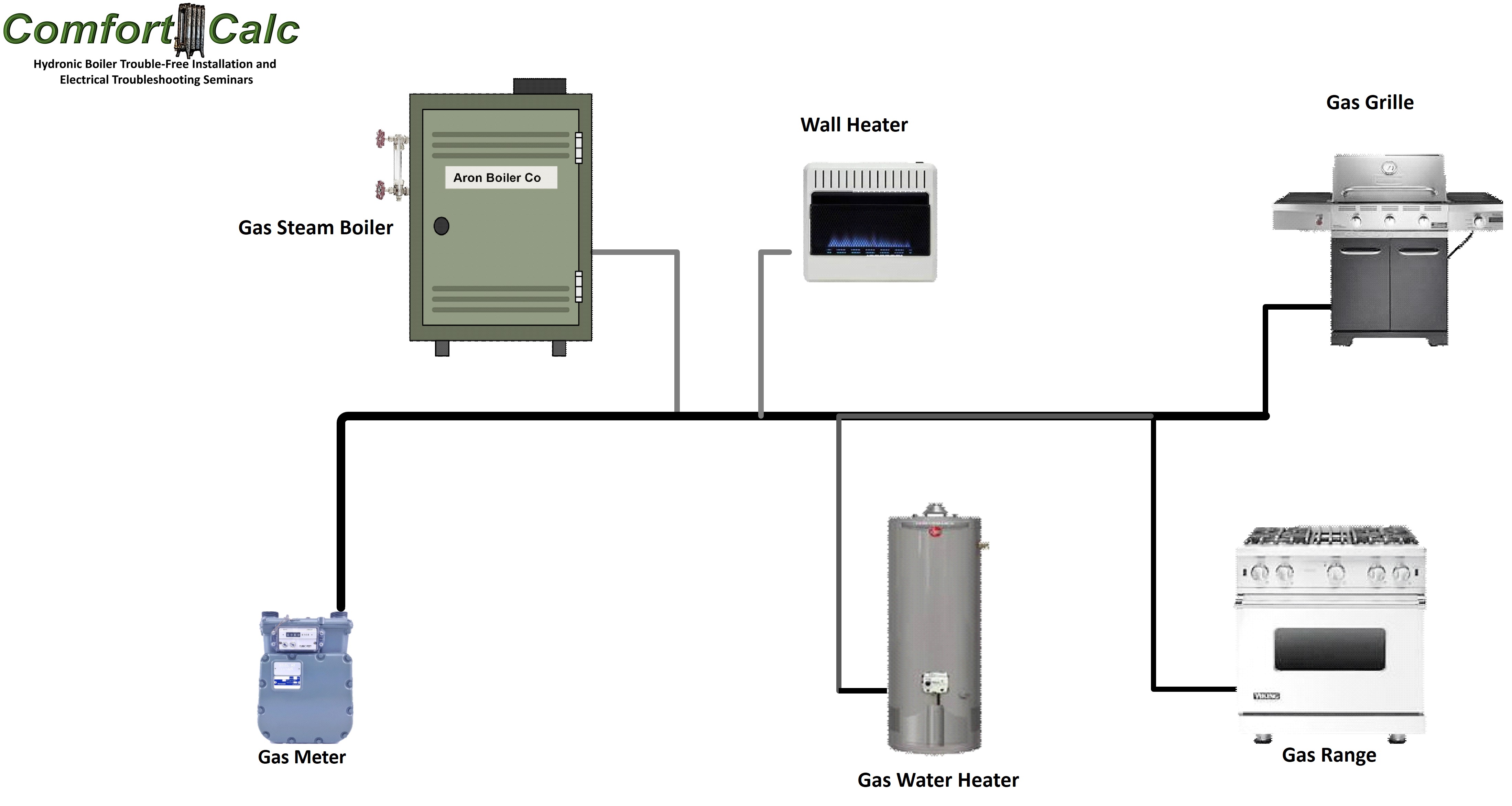
Calculations for the branch-length method determine the longest pipe from the meter or pressure regulator to the furthest appliance. In the above example, the longest pipe is 81 ft. Here is the chart for Natural Gas. When calculating the longest pipe, if the pipe is 1 foot over the chart length, go to the next line. For instance, if the pipe is 81 ft, use the 90 ft row or column. If a chart you are using for natural gas is using Cubic feet, divide the Btus by 1000, and you are using LP, divide the Btus by 2616.
Here is the information we gathered
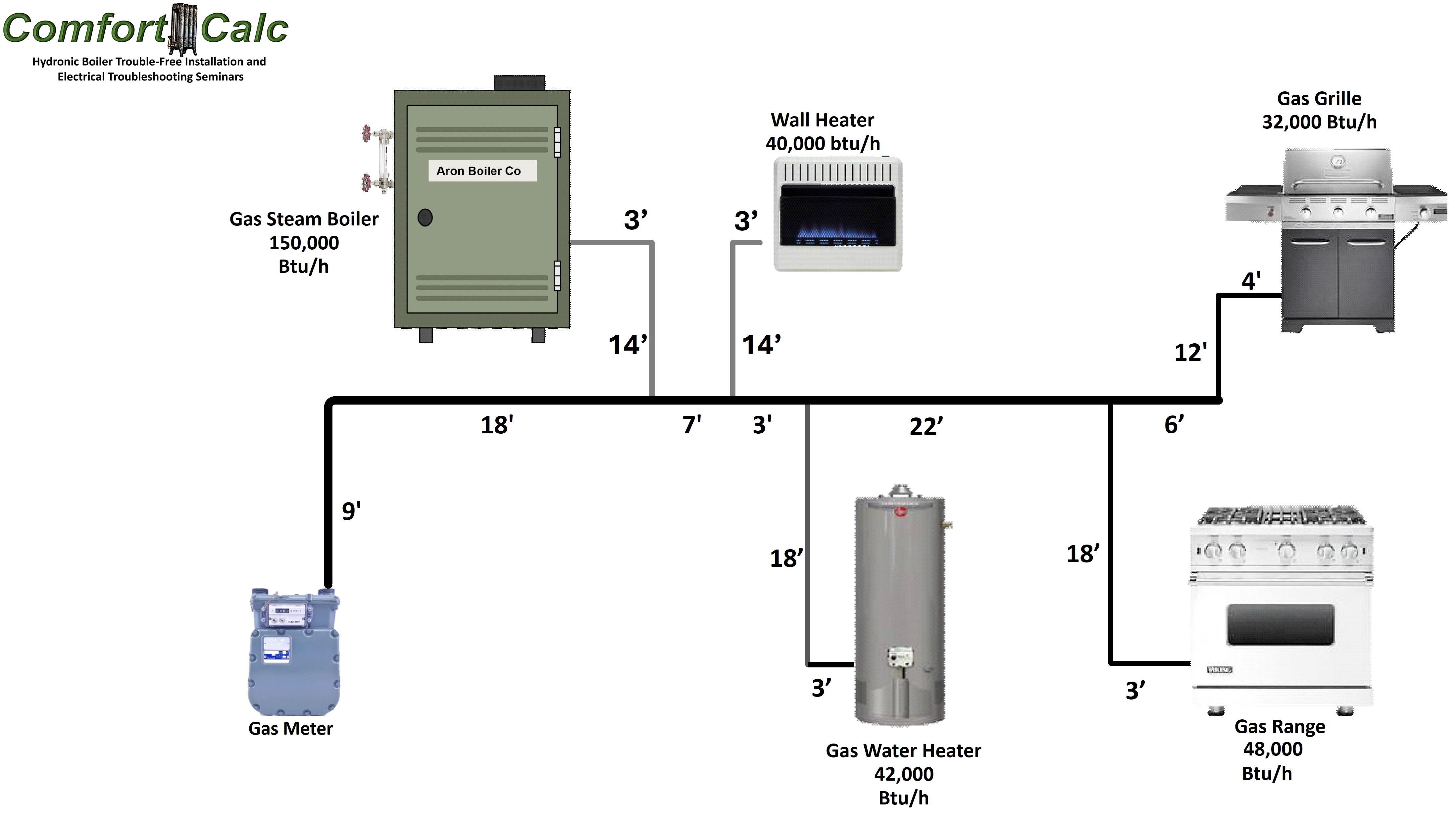
The overall length of the pipe to the most distant appliance measures 81 feet. Select that column and identify the value that is at least 312,000 Btus corresponding to a 1-1/2" pipe. Checking the 100' column for a 1-1/4" pipe, the value is just 266 Btu/h and would not be enough gas volume.
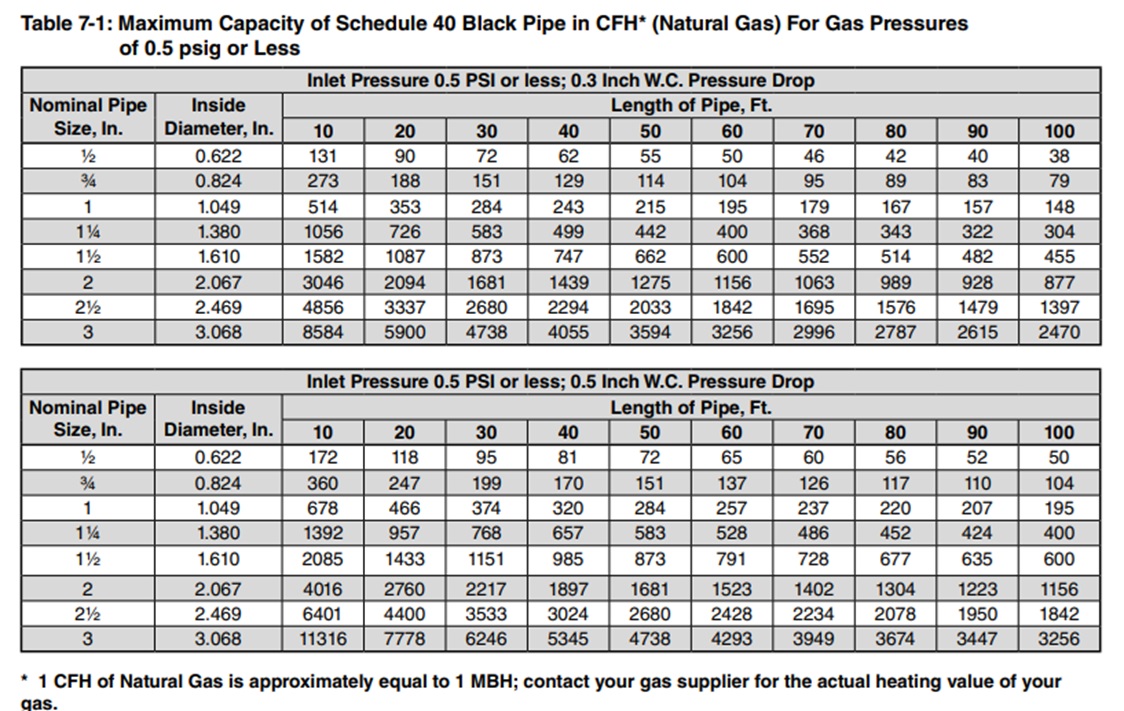
Referring to this chart, we will select the 90-foot pipe length and keep in mind that we are using the bottom chart heading for the 0.5" PD chart.
- Natural or LP gas - We'll choose Natural gas
- Btu/h or Cubic CFH - Let's CFH
- Total Load - (48,000+40,000+32,000+150,000+42,000)=312,000 Btu/h
- Convert to CPH -312,000/1000 = 312 CPH
- Longest Pipe - (9+18+7+3+22+6+12+4)=81 feet
- Pressure Drop - Let's choose 0.5" w.c. Pressure Drop
Let's begin calculating the longest length of the main line. We'll start from the meter to the gas grill, which is 81 feet away, meaning we will use the 90-foot column because 81 is larger than 80. Then we'll determine the reduced-diameter sizes of the main pipes, followed by the branch pipe sizes.
To determine the size of the main pipe and decrease its diameter along its length, the initial tee fitting connects to the boiler. Up to that point, the main pipe "A" carries the full 312 CFH of gas. Referring to our chart at 90 feet, we locate the row with a value not less than 312, but the next highest number, which in this case is 424 CFH
Our next step is to deduct the boiler CGH from the entire load of 312 to determine how much gas pipe "B" needs to carry 162 CFH. The length of that pipe is from the meter is 9'+18"+7'+3"+22'=59'. We will use the 60-foot length on the chart. We had 162 CFH. We removed 83 for the Water heater and wall heater, leaving 80 CFH for main pipe "C". Pipe "C" length is 6+22+3+7+18+9=65 feet. We must use the 70-foot-length column to find 80 CFH. That pipe size would be 3/4" pipe.
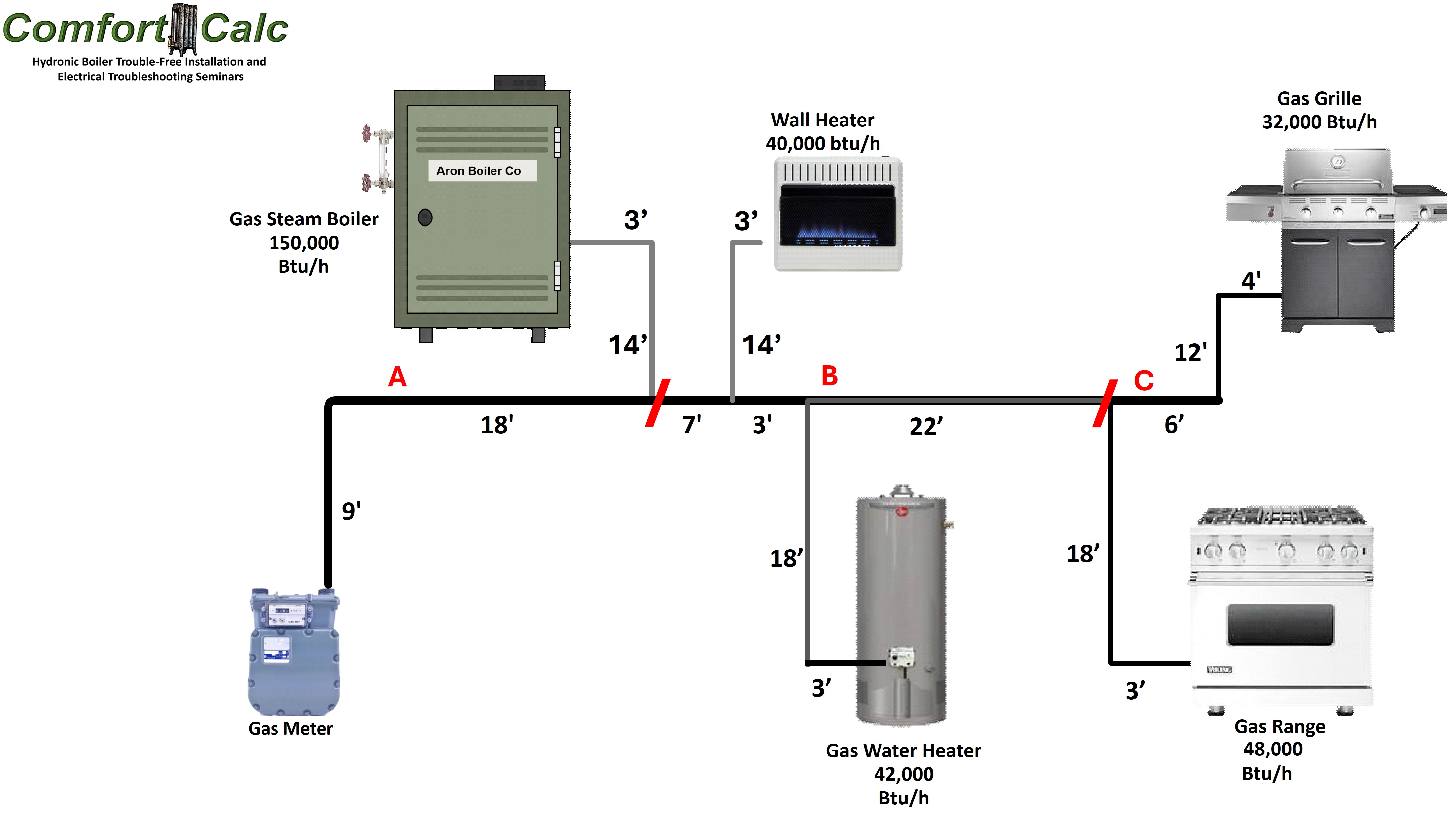 We now need to determine the runout size for the appliances. These measurements will be taken from each appliance to the meter or regulator. Since the boiler is the first off the main, we measure from the boiler to the main and then back to the meter. The distances are 3' + 14' + 18' + 9', totaling 44'. This is rounded to 50 feet. The boiler requires 150 CFH on a 50-foot length column, so the pipe size should be 3/4".
Next is the wall heater, rated 40 CFH, with a length of 3'+14'+7'+18'+9' = 51', rounded up to 60'. Find 60' at 40 CFH. Pipe size is 1/2".
The next item is the water heater, rated at 42 CFH. The total pipe length is 3' + 18' + 3' + 7' + 18' + 9' = 58 feet, which is rounded up to 60 feet. With a load of 42 CFH and a pipe length of 60 feet, the pipe size is 1/2".
Let's determine the gas grille size similarly. The total length is 4' + 12' + 6' + 22' + 3' + 7' + 18' + 9' = 81 feet, rated for 32 CFH. Rounding 81 feet up to 90 feet at 32 CFH requires a 1/2" pipe.
Finally, we size the runout pipe for the gas range rated at 48 CFH. Summing the pipe lengths 3' + 18' + 22' + 3' + 7' + 18' + 9' equals 80 feet. For a gas range rated at 48 CFH with a pipe length of 80 feet, a 1/2" pipe is needed. Below is the completed drawing. You can observe that the Branch-Length method involves more steps, which is why the Longest-Length method is more commonly used in residential settings.